

Tokyo Tales. Article 6
First published in the UK in September 2007
Dogs of Tokyo
Tokyo is teeming with dogs. And most of them are smaller than my cat! Pocket-sized pooches are a fashion accessory, so breeders are producing dogs small enough to fit into a handbag. They’re the canine equivalent of bonsai trees. Most Tokyoites live in small apartments and with few places for a dog to run free, the dogs need to be tiny to suit the city lifestyle.
Dogs here are a form of conspicuous consumption and cost an inordinate amount of money, upwards of £1000.00 for a miniscule pup. Pet shops only sell very young puppies. As the puppy matures, the price reduces as “nobody wants an older dog”, according to one pet shop owner. My friend recently bought a three-month-old Dachshund for the greatly reduced price of £250; I shudder to think what happens to the dogs once they get older than this. (NB I’ve since learned what happens to the older pups – you don’t want to know.)
Apparently, there are more dogs in Tokyo than children, so the dogs become child substitutes. These miniature canines are pushed around in special doggy buggies, transported in exclusive dog handbags, or just carried. It’s rare to see a mini-dog actually walking, although there is a dog-walking area near me. Owners dress their dogs in their best clothes, congregate there to meet other diminutive dogs, and then exchange their dog’s meishi – name and address cards.
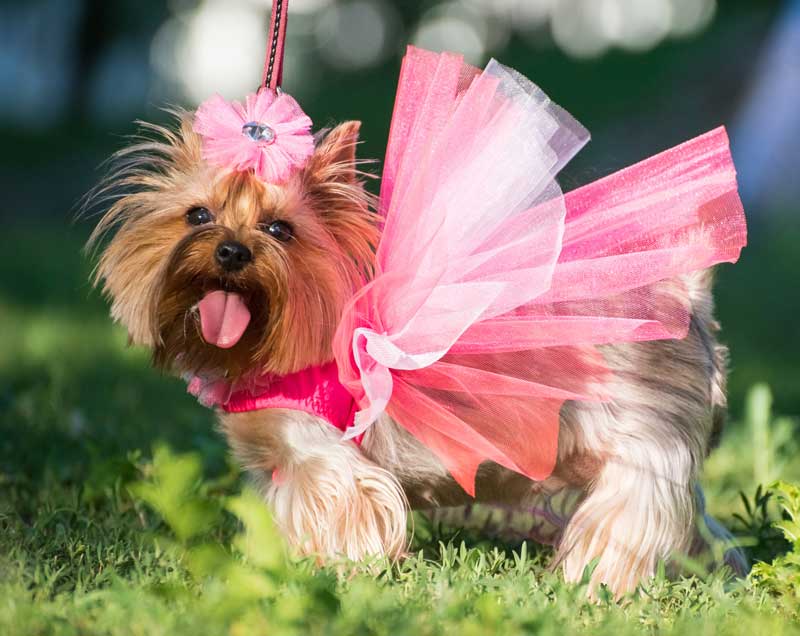 It’s rare to see a ‘naked’ dog and clothes shops for dogs are everywhere. They sell anything from t-shirts to dresses, bunny costumes to kimono, all complete with accessories like little backpacks or rhinestone collars.
I’ve seen a Dachshund dressed as a zebra, complete with zebra ‘head’, a Yorkshire terrier dressed as a ladybird, and yet another wearing sunglasses. Other costumes that have caught my eye are dogs in corsets, leather jackets, and even dogs in nappies. My daughter’s favourite has been a pink poodle, wearing a tutu with ribbons around its ears and pom-pom tail.
Of course, these dog-children need pampering too, so there are numerous salons where your dog can get a haircut, highlights, or even hair extensions.
A friend’s dog had dry skin, so she took him to one of these places where her dog was treated to an aromatherapy massage followed by a special mud pack. Then he was wrapped in clingfilm and placed under a heat lamp for a while. Apparently, he loved it!
There are also dog cafés which look exactly like human cafés. Feeling hungry one day, I stopped to grab a snack. With my lack of language skills, it took the staff some time to explain to me that the beautifully displayed food was actually dog food.
Of course, this attention is not all one way. The most famous dog in Tokyo is a loyal Japanese Akita called Hachiko who was owned by Professor Ueno in the 1920s.
Hachiko used to wait at Shibuya station every day for his master to return from work. On 21st May 1925 the Professor didn’t come home as, sadly, he had died at work. Hachiko waited and waited. Poor Hachiko returned to the station every day at 3 o’clock to meet his master’s train, for nearly a decade.
Word spread and people visited Shibuya just to see this loyal friend, to bring him food and to pat his head for luck. Then on 7th March, 1934 Hachiko was found dead at the same spot outside the station where he’d spent so long waiting for his master.
Hachiko’s death made the front pages of all the newspapers, and a day of mourning was declared.
Later, a statue of Hachiko was erected where the faithful dog waited for so long, and it’s now an important meeting place for everyone visiting Shibuya.
