

Tokyo Tales. Article 19
First published in the UK in October 2008
Japanese Toilets
Of the many questions I’m asked about life in Japan, a frequently recurring one is on the subject of toilets. Many people have heard of the automatic cleaning, high-tech gadgetry for which Japan is famous and recall various stories on the latest invention in the world of sanitary systems. But are you aware of exactly what they can do?
 There are two basic types of lavatories here: the familiar Western style and the Japanese squat toilet, with the Japanese version being the most common in public toilets. Thankfully, there is a handle to hold on to assist untrained leg muscles. Graphic pictures are often posted on the wall to illustrate the correct method of using the squat toilet.
The Western style toilets are very talented with a huge number of features incorporated in them, complete with a spaceship-style control panel. Unfortunately, this is almost always written in Japanese so there have been some ‘interesting’ and rather unnerving moments when I’ve inadvertently pressed a button!
One of the more unusual aspects of spending a penny in all public toilets is the motion sensor that starts the sound of running water. This is found only in the women’s cubicles and is designed to cover the sound of bodily functions. It just needs a wave of the hand or general proximity to set it off and has the tendency to make me jump even now. Some play loud piped music instead: ‘Ave Maria’ is a favourite.
When it comes to the modern Western toilet, the functions incorporated are amazing. The lid lifts automatically upon entering the cubicle, the toilet seat is heated – which is pleasant in the chilly winter and sometimes you find a toilet that glows in the dark. In the summer, a few have under-seat air conditioning, but this is not as pleasant or as popular as the heated version.
Built into the toilet is a bidet, with a directional hose, a choice of water temperatures, variations on water pressure, pulsating and massaging options. Instead of toilet paper you can use the warm air blow dryer. When you’ve finished, the most modern ones flush automatically and close the lid for you.
Flushing the toilets is often an exercise in exploration: is the flush one of the many unreadable buttons, a black sensor on the wall or a manual handle cunningly hidden behind the open lid? Some minutes can be spent randomly pressing buttons in the hope that one of them will actually be the flush.

Many home models have a ‘learning mode’ which memorises the times when the toilet is used and only heats the seat in time for this, therefore saving electricity. Some very recent inventions include medical sensors to measure sugar in the urine.
All these fancy functions have a potential for disaster. Last year, the main manufacturer of these toilets had to offer free repairs to 180,000 lavatories which developed wiring problems causing several seats to catch fire. Luckily nobody was injured.
In restaurants you find pairs of shoes just inside the door. These are ‘toilet slippers’ and you put them on before entering and removed after leaving. Some toilets are shared by both sexes, with a urinal in the first room, and a closed-door cubicle beyond. Which means you have to pass the urinal to get to the cubicle.
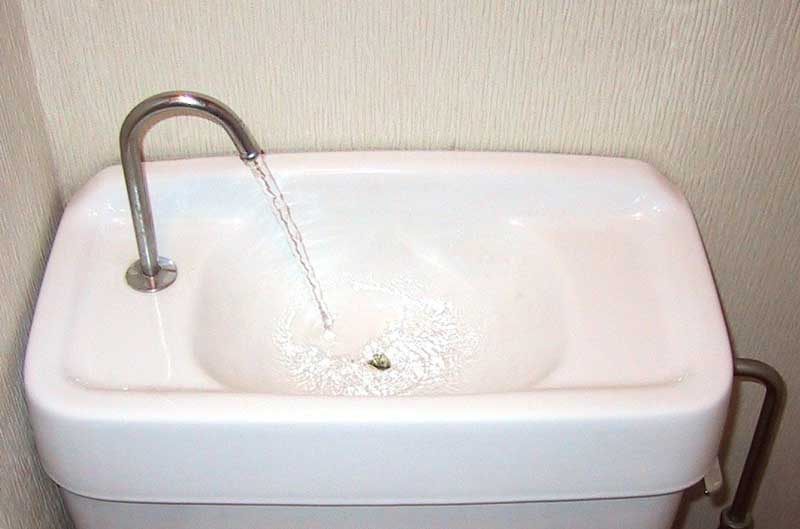 An interesting addition to the range of lavatory systems available is one found in ecologically aware places. After flushing, these toilets send the water that fills the cistern out through a tap over the top of the tank so you can rinse your hands while conserving water.
There is rarely anywhere to dry your hands by the basins in public toilets. Everyone carries little personal towels with them for this purpose, which are the size of a small flannel. Incidentally, these towels are considered a standard and welcome gift to give anyone you visit.
If you really want to see these ‘bidet toilets’ in action, look at this American website. You’ll see the kind of surprise that awaits the unsuspecting user…!