

Tokyo Tales. Article 11
First published in the UK in February 2008
Getting Married in Japan
Spring and Autumn are the preferred times for a wedding to take place, and couples seek the advice of the Japanese almanac to decide the most auspicious day.
“Western-style” weddings are becoming increasingly popular due to their perceived romantic style, and they are often chosen as a fashion statement. But to me, the traditional Japanese Shinto wedding is most spectacular. Some elements of the Christian wedding, such as exchanging rings and cake-cutting are now incorporated into the Shinto wedding, but many ancient customs still take place.
A Shinto wedding is performed in front of the Sanctuary, (similar to an altar) at a shrine or in a special, sacred room of a smart hotel. The wedding procession of the couple and their immediate family makes its way to the Sanctuary, escorted by attendants. The couple are sheltered by a huge red parasol. Colour plays a large symbolic part in the ceremony with red and white being the main colours; red brings happiness, and white symbolises purity.

The priest performs the short and simple ceremony which starts with the purification of everyone in the room and is followed by vows similar to a Christian marriage. Traditional and haunting Japanese flute music accompanies the service. After the vows, the couple share sake in an ancient ritual. After that, the sake is passed to the rest of the family by attendants dressed in red and white. Finally, the couple present offerings to the Kami (Gods) at the Sanctuary.
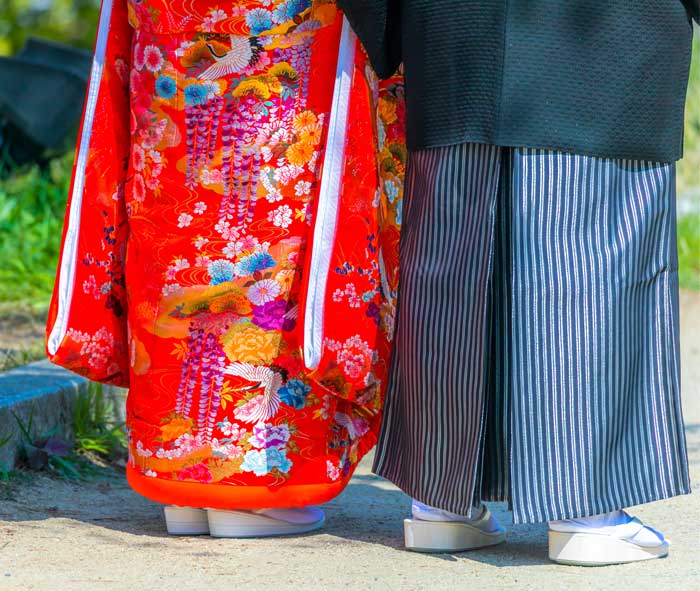 The groom wears a short haori coat decorated with the family crests and pleated hakama trousers, while wedding guests tend to wear black as a sign of high formality. Married lady guests may wear very formal kimono, again, black in colour but with a colourful and tasteful design around the base.
The bride’s costume is spectacular.
The white wedding kimono is called shiromuku, and a large hood called a tsuno-kakushi or “horn-hider” covers her elaborately styled hair. Her hair is a complex arrangement adorned with beautiful ornaments, including gold tsuno – horns. The hood covers these horns to symbolise her obedience to her new husband. The bride’s wedding kimono actually consists of two different kimono: the white one for the ceremony and a magnificent, coloured one called an uchikake, worn over the shiromuku for the wedding reception. The uchikake is usually red, very gorgeous, and heavily embroidered with gold and auspicious symbols. It’s often handed down through the family or rented at a hefty price. Both kimonos are extremely long, all the way around, and the bride needs help from her attendant to hold it up.

Certain accessories are traditionally worn with the wedding kimono for good luck; she carries a small bag and a tiny sword and tucks a fan into her obi.
Once the ceremony is over, the wedding party head off to the reception, where more distant family, friends, and work colleagues are waiting. Guests bring a gift of money, enclosed in a special envelope. The invitation often states how much should be brought, and it’s not a small amount. Friends would be expected to gift about £150.
The bride will change her clothes several times during the reception, and often the groom will too, maybe changing into a dinner jacket to match his new wife’s evening dress.
During the reception the bride and groom sit on a stage watching the guests’ speeches and performances. That’s right, performances! If you get invited to a Japanese wedding, you may be expected to sing a song to them or recite some poetry.
At the end of the reception, each guest is given a sort of a party bag to take home as a souvenir. This traditionally contains dried fish and sugar, symbolising happiness, as well as more valuable and desirable items such as silverware, sake, cakes, and even jewellery and watches.
As you can imagine, a traditional Japanese wedding works out as a very expensive option, which is why more people are turning to the Western style marriage ceremony.
But, for spectacular and ceremonial value, I think the traditional Shinto style has much going for it.