

Tokyo Tales. Article 8
First published in the UK in November 2007
Superstitions and Beliefs in Japan
A fascinating conversation prompted me to investigate Japanese superstitions and beliefs. My Japanese friend was perplexed when I spontaneously remarked, “Bless you” when she sneezed. Her bemusement came from her belief that the sneeze indicated that someone was speaking ill of her, so why would I invoke a blessing, and therefore, agree with the sentiment?
As in Britain, some superstitions in Japan are considered amusing and foolish, but many are taken very seriously indeed.
As a rule, the more acknowledged taboos are associated with death.
- Never set your bed with your head facing north as this is the way the dead are laid out.
- Don’t stick your chopsticks upright in a bowl of rice because this is how rice is presented at a funeral.
- Passing food from chopstick to chopstick is wrong, as bone fragments from a cremated body are passed from person to person using chopsticks before being placed in an urn.
- Cutting your nails at night is considered a bad move, because it means you will not be with your parents when they die. Likewise, wearing socks in bed brings the same misfortune.
Superstitions surrounding numbers form a huge part of Japanese life. Essentially, this stems from homophones: words that sound identical, or similar, to other words with negative meanings. Most notably, the number four is considered the most unlucky. In Japanese, ‘four’ is pronounced shi, which is also the same word for death. Nothing is produced in sets of four.
The number nine is also avoided, due to the phonetic connection with the word for pain, suffering, or worry. Hospitals never have fourth or ninth floors and wards are also carefully numbered. ‘Forty-two’ is pronounced shi-ni, which also means to die, and ‘forty-three’ is banned in maternity hospitals as the number translates as ‘still-birth’.
Not all superstitions are doom and gloom though.
It is considered good luck to see a spider in the morning, but bad luck if you see one at night, so you can kill it with impunity. This is definitely bad luck for the spider.
Family life has several unusual beliefs too: for example, having a hangnail means you haven’t been listening to your mother!
Keeping the bathroom and toilet spotlessly clean daily is a must. A goddess called Kawaya Kami lingers around the bathroom, so by keeping her domain spotless you please her, and then she will bless the family with fertility, good harvests, and attractive children.
What did your mother tell you to eat to make your hair curl? Children here are encouraged to eat their hijiki to make their hair black. Hijiki is black string-like seaweed.
And as for pregnancy, old wives’ tales abound here as well as everywhere else.
Expectant mothers are encouraged to eat lots of top-quality sushi to increase their child’s intelligence. Recent medical studies have proved some truth with this belief. However, while pregnant, one also shouldn’t eat seafood with claws, like crabs and lobsters, otherwise their offspring will become criminals.
Also, don’t sit with your legs crossed as you will suffocate the baby.
During thunderstorms, young children can often be seen clutching their stomachs. It’s said that lightning comes down and might snatch their belly button!
 Shrines and temples sell many charms or amulets to help ward off evil or bring good luck. At almost every Shinto shrine and Buddhist temple, you can purchase an omamori, a talisman in the form of a small colourful brocade pouch which contains a tiny scroll inscribed with a prayer.
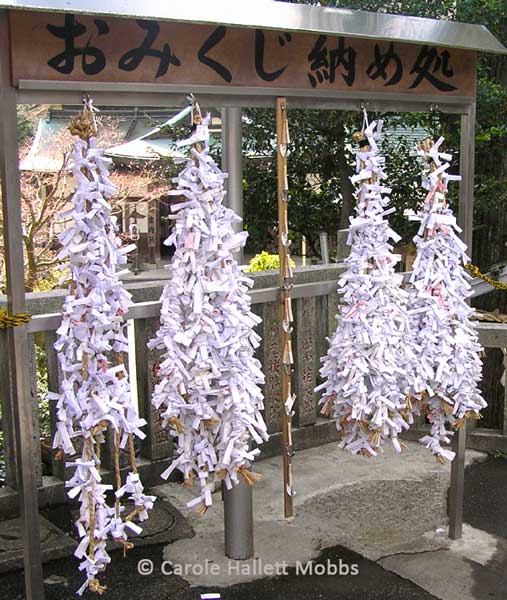 There are also ‘lucky dip fortunes’ called omikuji – tiny rolls of paper on which a destiny is written. If you pull out a good fortune, keep it; but if it’s unpleasant, you can leave it at the shrine by tying it to a nearby stand, as shown here. The idea is to leave the bad luck at the shrine, where the divine spirit can exorcise it.
I wish you all good luck and fortune, until next time, fingers crossed and touch wood!