

Tokyo Tales. Article 16
First published in the UK in July 2008
Summertime in Tokyo
Summer in Tokyo is hot. Very hot. And humid. In fact, the sultriness can be so oppressive that you tire out quickly and just standing still outside makes one perspire. By July, the rainy season is hopefully just ending but the heat is almost unbearable, averaging 30°C.
Luckily the Metro and all the shops are air-conditioned, but once you step outside the humidity hits you like a damp flannel.
Most people, if they are able, get out of the city over the weekends or the school summer holidays and head for the mountains where the weather is more conducive to happy living. Alternatively, trips to a nearby seaside provide a welcome relief from the city heat.
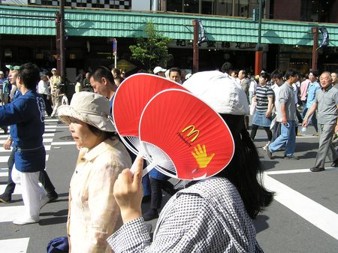 For those left in Tokyo, we use freebie paper fans widely distributed at Metro stations, which are vaguely helpful but are mainly a good advertising medium for big companies. Most activity takes place when the sun goes down and people head towards the rivers for the modest cooling effect provided by the water.
Many restaurants along riverbanks have outdoor terraces, so you can either brave the mosquitoes and sit outside gazing at the working river and lights or sit inside with the air-conditioning. I choose indoors.
July is also a time of festivals, called matsuri. Mind you, there are scores of festivals in Japan, so I’ll comment on some more of them in future articles. One favourite festival in July is an enormous firework display called Sumidagawa Hanabi Taikai, the Sumida River Fireworks Display. The Sumidagawa fireworks festival can be traced back to around 1732, when fireworks were launched as part of festivals for the dead.
The Japanese word for firework is hanabi, which translates literally as ‘flower-fire’, conjuring up an accurate and exquisite image.
On the last Saturday in July, Asakusa, one of the older areas of Tokyo located along the wide Sumida River, is the setting for this impressive spectacle. This display is a competition between rival pyrotechnic guilds. Each group tries to outdo the other with the result being a most astounding sight.
Complex shapes created from tens of thousands of fireworks include Kanji (Japanese writing) and popular cartoon characters.
All viewing areas are chock-a-block with around a million people who crowd the streets, bridges, and all accessible rooftops, with many claiming their spot first thing in the morning. Those lucky enough to have boats put them to good use by thronging the river with bobbing spectator platforms.
Once darkness falls, a deafening boom signals the start of a 90-minute-long presentation of one of the best pyrotechnic displays in the world. The sky is vibrantly coloured with sparking ‘flower-fire’ and the excited crowd cheers in time-honoured tradition.
When the display has finished, it’s time to head back into the blessed coolness of the air-conditioned Metro for the journey home, hot, clammy, tired, but exhilarated.
