

Tokyo Tales. Article 17
First published in the UK in August 2008
A Summer Festival to Honour Ancestors
Obon is a family-orientated festival held in Japan during July or August depending on the region. In Tokyo, Obon is held around the middle of August. This centuries old Buddhist ceremony is a memorial festival to honour one’s ancestors. Obon is one of Japan’s three major holiday seasons when families try their hardest to get together.
 The belief is that each year during O-bon, the spirits of our ancestors return to this world to visit relatives. Lanterns are hung in front of houses to help guide the spirits home; families gather at the graveyard to reminisce about lost loved ones, and food offerings are made at temples and small altars within the home.
These home altars are very common and can be purchased from most department stores or specialist shops. The altar is decorated with flowers and tiny paper lanterns which are lit on the first day of the festival and on the last day these little lanterns are lit at the graveside to guide the spirits back.
During Obon, ritual folk dances called bon-odori are held all over Japan. We went to a local one last summer, which was a moving and spectacular event.
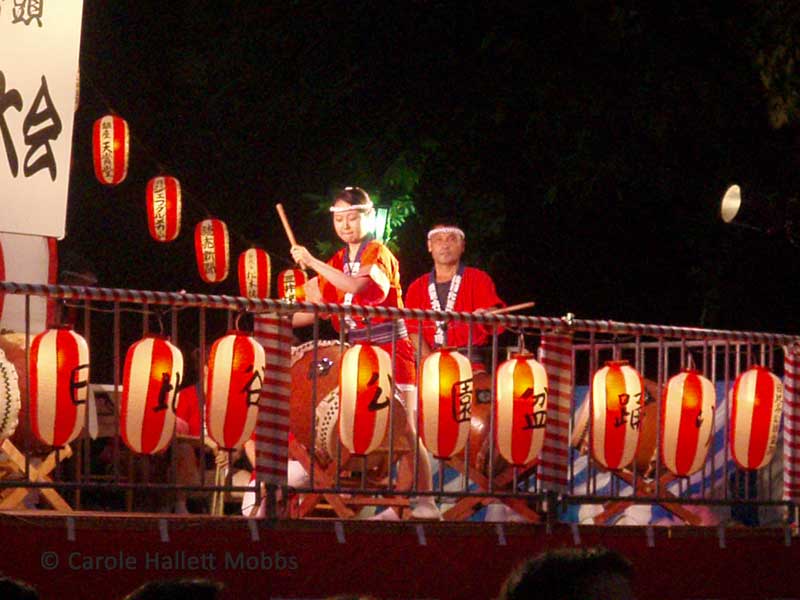
The festival was held in a park square with a large fountain as the centrepiece. The fountain was lit by multicoloured changing lights, and at one end of the square a tall platform was erected on which taiko drummers performed. Above our heads were streamers of red lanterns and around the circumference of the park were stalls selling all kinds of food, drink, and most importantly, shaved ice – it was extremely hot even though it was evening.
Many people gathered around the fountain, most of whom were wearing light cotton summer kimono called yukata. Some groups of ladies were wearing what appeared to be a uniform with matching yukata and obis. Everyone carried fans which were tucked into the back of the obi when not being used.
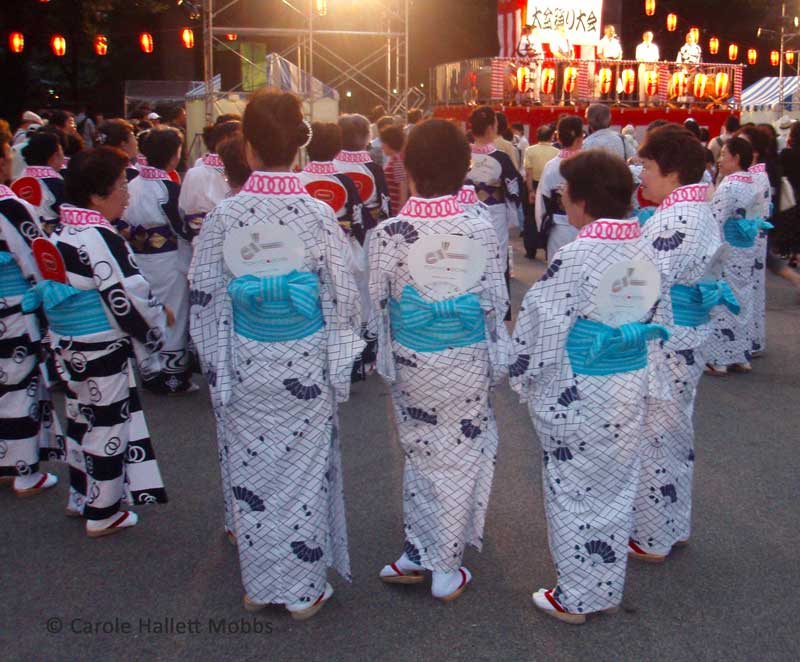
Music started with the pounding rhythm of a number of large taiko drums.
Each region has a specific local dance and the way in which the dance is performed differs throughout the country. Typically, the people line up in a circle and move around either the stage or in this case the fountain. The dances apparently depict the area’s history, geography or specialisation, so, some dances may show the movements of miners, rice picking or rivers and mountains.
What was depicted by the dancers we watched is a mystery to me, but the hand gestures and gentle movements were incredibly elegant and beautiful. Often fans were used in the dance, which served to emphasise the gracefulness of the moves.
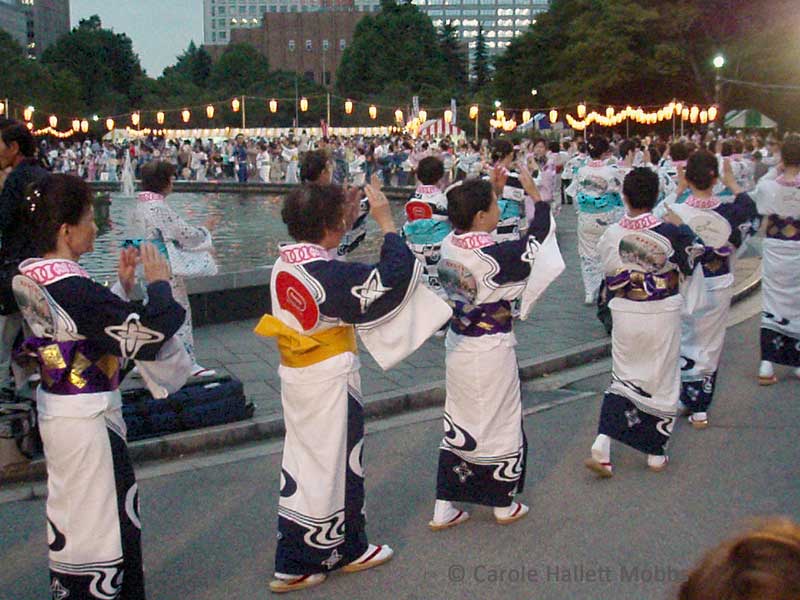
Everybody joined in including my daughter and her friends who were accepted with a smile and a helping hand. What amazed me most was how all members of society joined in, from elderly gentlemen to leather-clad youths, each knowing the precise and intricate choreography of each dance.
This spectacle was repeated over and over again, the music and steps changing occasionally, until finally a compere arrived on stage to sing special Obon songs and announce the end of the ceremony.
In some places the end of the festival is marked by floating the lanterns down rivers and streams in a symbolic signal for the ancestors’ spirits to return to the world of the dead.